

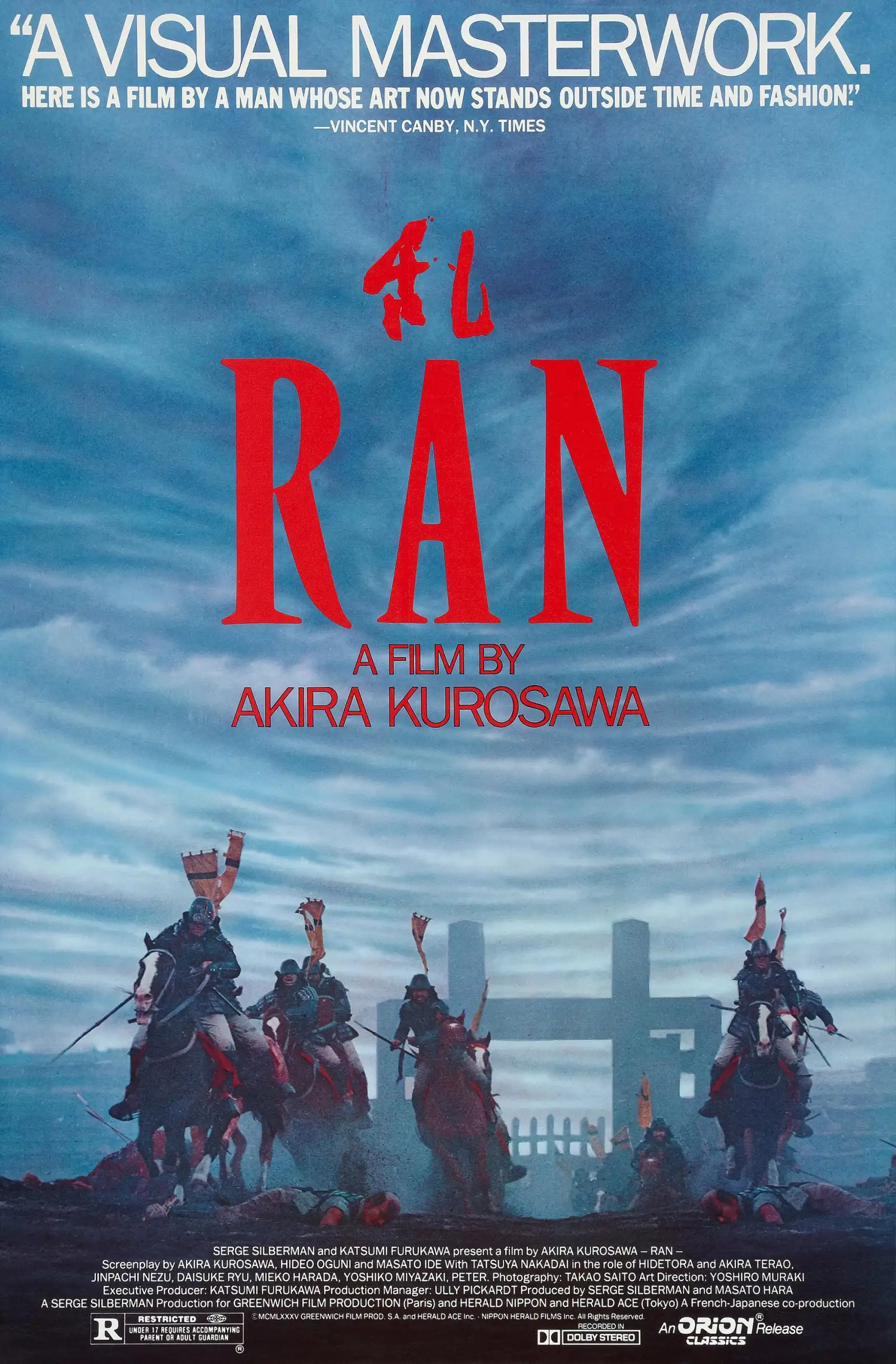
Ran
Overview
In Medieval Japan, an elderly warlord retires, handing over his empire to his three sons. However, he vastly underestimates how the new-found power will corrupt them and cause them to turn on each other...and him.
Cast
-
 Tatsuya Nakadai Lord Hidetora Ichimonji
-
 Akira Terao Taro Takatora Ichimonji
-
 Jinpachi Nezu Jiro Masatora Ichimonji
-
 Daisuke Ryû Saburo Naotora Ichimonji
-
 Mieko Harada Lady Kaede
-
 Yoshiko Miyazaki Lady Sue
-
 Hisashi Igawa Shuri Kurogane
-
 Pîtâ Kyoami
-
 Masayuki Yui Tango Hirayama
-
 Kazuo Katô Kageyu Ikoma
-
 Norio Matsui Shumenosuke Ogura
-
Toshiya Ito Mondo Naganuma
Watch Ran Online Free on World4ufree
Ran (1985) is available to stream free in HD on World4ufree. This movie sits in the Action, Drama, War categories and was produced in Japan. Watch it online without signing up, or download it where the source allows.
Press play to start watching immediately — there is no sign-up, no subscription and no app to install. The player remembers your position, so you can close the tab and resume later. Subtitles and quality options are listed on the player page.
If you enjoy Ran, the recommendations below are the closest matches in the World4ufree catalogue by genre, country and audience.
More like this
Available Subtitles
English,Filipino,Français,Indonesian,Português,Русский,اَلْعَرَبِيَّةُ,اُردُو,বাংলা,ਪੰਜਾਬੀ
I love the colorful atire and well out story.. Ran is a perfect break from modern cinema - there's something bout historic dramas we now lack
I watched this movie a couple of days ago and, despite its credits given by critics, I must admit not liking it at all. The script is indeed potent, but the way it's materialized fails much behind the director's goals. First of all, this had to be a dramatic movie, while it's actually not. Drama is realized through superficial means and honestly convinces no one. It rather depends on costumes, declamations, stereotypic behavior and forces of nature to achieve something which had to be achieved through EXPRESSIVE ACTING alone. The story drags and the empty space is filled by artsy artifice. All characters are one dimensional and badly acted. Some may argue overacting is a respectable Japanese fashion, but I still don't like it, because it forbids someone to immerse into the plot. The only interesting (and realistic) character is Lady Kaede, also the only one enjoying a respectable performance. The first battle scene is outright ridiculous. Blood has orange colors (!), dead heroes stack one against another in a "dramatic" mass of arrows and bullets. Everyone dies except, of course, our main character, bound to have a more dignifying fate and miraculously surviving masses of stray bullets. If the movie ended there, having the main character avoid capture by committing seppuku, or even fearing taking his own life and letting bullets do the work, I would have found the movie enjoyable. But the movie goes on much more into a totally contrived and predictable direction. The end was
Ran is a second-rate retelling of the Lear story, so the flaws in the plot are easiest to explain with reference to King Lear. These are some of the important differences: the subplot is dropped; Goneril and Regan are turned into effete men; an injured and vengeful daughter-in-law is introduced; the Lear-figure (Hidetora) is a warlord rather than a king; the mad Lear scene is weakened to insignificance; the sons try to kill old Hidetora by having a few thousand men fire at him as he sits in a castle; and the additional character of Tsurumaru, a boy who was blinded by Hidetora at some point in his murderous career, is introduced. Hidetora is a smaller man than Lear; he has the stubbornness without the nobility. His abdication is also a lot sillier. Lear errs by trusting that people will treat him decently: Hidetora errs by supposing that they will forget that they hate him. This is also much more implausible. After all, there is nothing monstrous or unnatural about the daughter-in-law's attitude towards Hidetora; she just wants her back, and with reason. This diminishes her, and in spite of Kurosawa's attempt to make her a sex maniac, she is not as large or as interesting as Goneril/Regan. Unlike Lear, Ran does not give us a sense of the insignificance of Man in nature. The "majestic" (read pompous) scenery shots don't make us feel that Man in general is helpless—these are no giants to be dwarfed by Nature, just a murderer and an injured woman and several wimps. The strong sto
Realizing that it is practically heresy in the film world to criticize a Kurosawa film, much less downright dislike it, I'd like to precede my review by saying that I have absolutely loved every Kurosawa film I've seen until now. "Ran", Kurosawa's 1985 film based somewhat on Shakespeare's "King Lear" is the story of an elderly emperor who hands down his kingdom to the oldest of his three sons. While the oldest and middle son fan over each other, saying that they are not deserving, etc. it is the youngest who speaks his mind about the subject, incurring the wrath of his father and ultimately, banishment from the area. Meanwhile, the two older sons are making a mess of things with the kingdom, leading to wars, fratricide and the dismissal of their father, even attempting his murder. None of their motives are noble or honorable, only avarice and power motivate them, leading to tragedy for all. Going into this, I knew that this was not going to be a light story by any means. For anyone who has read or is familiar with Lear, it is a story that is pretty much slogged through, though it is wonderfully told. "Ran" can pretty much be described the same way. While I certainly appreciated the good acting, the unbelievable costumes and the set design as a whole, I found myself unable to become engaged in the story. The pacing was extremely slow, certainly not an easy thing to deal with during a film that lasts about 2 hours and 40 minutes. Unfortunately, for myself at least, it is the
What a wonderfully varied medium film can be! Here we have a film that is both truly great and in a different way a clumsy mistake. By now you know that this was made by a master filmmaker at the end of his life -- in preparation for ten years and Asia's most expensive film. He intended it to be his last, his masterpiece. The Good: This work of art is a sequence of masterfully composed images. The camera remains stationary or virtually so, and each scene is richly rewarding in all the visual dimensions, including motion. The costumes are the most cinematic I have seen. There is a use of grasshopper sounds that is the best example I know of amplifying an image by sound. The frame of the picture is the landscape -- little takes place indoors, and that action always refers to some larger, exterior motion. In my experience, this is the best complement of Wells' Othello, the most masterful use of interior space I know. I give it a ten because it is a masterpiece in this area of cinematic communication, one that seems exceptionally underaddressed. The Bad: The Master attempted too much in trying to match his cinematic virtuosity by swallowing Shakespeare's Lear to produce an equally rich story. In this he fails -- so many problems here. First, Shakespeare wrote plays for a barren stage where the images grow from the mind, supported by super-rich language and interwoven visual metaphor. The scene grows from our understanding of the character and what that character says. Kurosawa tr
The 'Kurosawa' adaptation of King Lear in his film 'Ran' is a tremendous memorable film. It is a very dramatic film with many soliloquies and dialogue, but if you are patient with it, you are treated to some of the most epic scenes of cinematic brilliance that Kurosawa made. After all it is Shakespeare and one must be patient with it if they are not a fan of the old school theatre. Colourfull clashing armies, The lord awaiting his fate in a burning castle, a brilliant execution scene (I consider the BEST I have ever seen film ever), and the blind being left in the hands of Buddha? While Seven Samurai will always be his perfection, Ran is more than an enjoyable movie that should be seen. Just stick with it and you'll never forget it. Rating 9 out of 10.
Ran takes viewers to a place they would rather not explore on their own. In a world of cruelty, Kurasowa has shown how the moments within the horror can have beauty. Shakespeare wrote King Lear as a mirror on the human condition. We do not have to be kings and princesses to identify with the father's desire for the well being of his children, even if his own life was one of cruelty and pain. We see this theme throughout great literature and film. What Ran has done is to provide the viewer with many small moments within the pain to realize the beauty. Even the moment of epiphany for Hidetora, when his actions achieve his madness, is one of surpassing beauty. As the storm rages outside the small house of the prince he blinded, whose parents he killed, whose sister he forcibly married off, the simple sounds of the flute provide an intense focus on the here and now. It is at this moment when Hidetora recognizes that he himself sowed the seeds of his own destruction. There is no dialogue, no swashbuckling, just the terrible beauty of the music. As with many of Kurasowa's films, despite their epic scope, it is the small paint strokes that make up the master's canvas.